
Underground drill rigs are purpose-built drilling equipment designed to operate inside tunnels, mine shafts, and subsurface excavations where ceiling height, ventilation, and confined working conditions make surface-style rigs impractical. They break rock, extract core samples, or drill blast holes for explosives — performing the same fundamental work as surface equipment, but in a fraction of the footprint and under far more demanding mining conditions.
At a Glance
| Attribute | Detail |
|---|---|
| Primary function | Rock penetration, blast hole drilling, and core sampling in underground spaces |
| Main rig types | Jumbo, production, longhole, and underground core drilling rigs |
| Drive systems | Diesel hydraulic, battery-electric, or air-powered systems |
| Typical working environment | Underground mines, tunnels, and confined excavation areas |
| Key applications | Underground mining, tunnel construction, and geological exploration |
| Key standards (U.S.) | MSHA 30 CFR Part 57 for underground metal and nonmetal mines |
What Is Underground Drilling Equipment?
The defining job of underground drilling equipment is rock penetration in confined, low-headroom environments. That sounds simple, but every design decision — power source, boom geometry, dust suppression, tramming width — flows from one constraint: the rig must fit inside the opening it is helping to create or exploit.
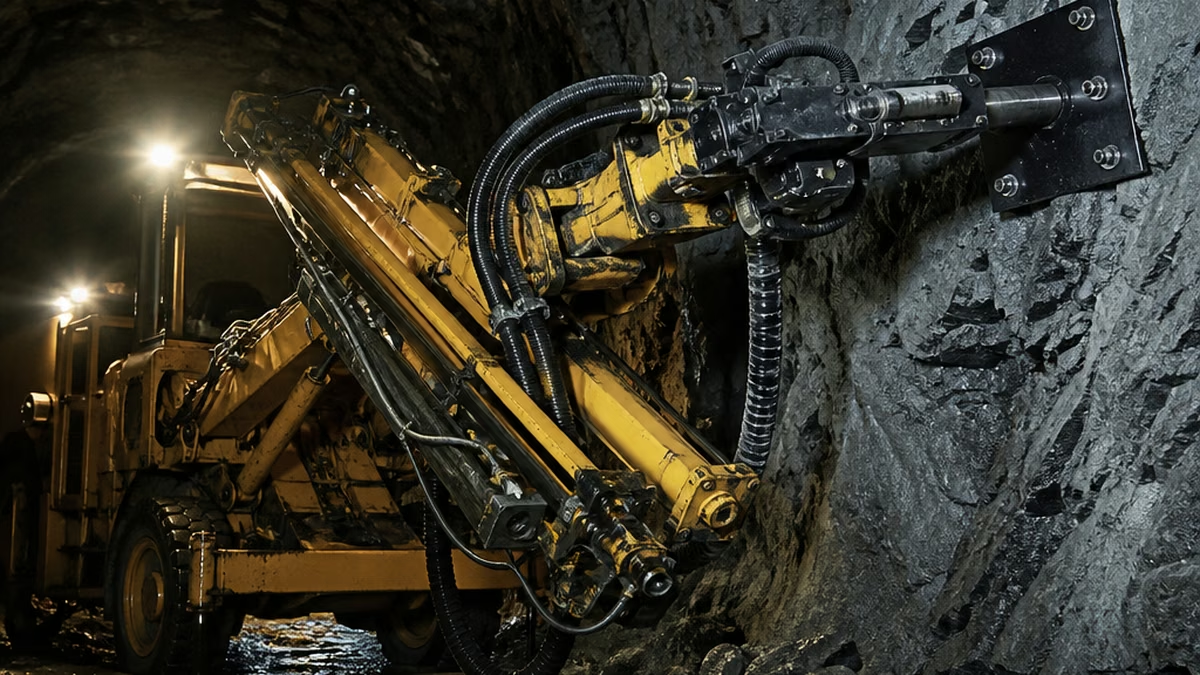
In U.S. mining, underground drill rigs are the primary tools for development headings (driving new tunnels), stope preparation, and mineral exploration programs. Without them, the progression from blast to muck to advance stalls completely.
⏱️ Time saver: When quoting underground drilling equipment for a U.S. project, request the rig’s tramming width and minimum working height upfront — these two figures alone eliminate most mismatches before a full spec review.
Key Components of a Drill Rig for Underground Use
Every underground drill rig, regardless of type, shares a common set of structural and functional components:
- Carrier/chassis — tracked or wheel-mounted base that moves the rig through underground workings; track-mounted units handle uneven ore-drive floors better than rubber-tired platforms in most hard-rock environments
- Boom and feed — the articulated arm that positions the drill steel at the correct angle; feed length determines the maximum hole depth per pass
- Rock drill (drifter or down-the-hole hammer) — the percussive or rotary-percussive tool that actually breaks rock
- Rotation unit — drives the drill string; in rotary drilling this is the primary energy transfer mechanism
- Water/dust suppression system — mandatory under MSHA 30 CFR Part 57[1] for respirable dust control in U.S. underground mines
- Hydraulic power unit — on modern rigs, a single hydraulic circuit drives feed, rotation, and percussion simultaneously
- Operator cab or ROPS/FOPS frame — protects the operator from falling rock and rib spall during drilling operations
4 Common Types of Underground Drill Rigs
Jumbo Drill Rigs for Underground Tunneling and Development
A jumbo drill rig carries two or three booms, each tipped with a hydraulic drifter, allowing a crew to drill an entire tunnel face pattern simultaneously. This is development drilling — the equipment that advances a new heading through solid rock.
Jumbos are designed for drill-and-blast cycles: drill a pattern of holes, load explosives, fire the blast, muck out broken rock, advance the jumbo, repeat. Cycle times in U.S. hard-rock development drives typically run 4–8 hours per blast round depending on face width and rock conditions.
Core Drill Rigs for Underground Exploration and Sampling
Core drill rigs extract intact cylindrical rock samples for geological analysis. The bit is an annular diamond-impregnated ring that cuts a core rather than pulverizing rock.
This is the equipment at the center of mineral exploration programs. Geologists log core to determine ore grade, rock quality, and structural geology — the data that decides whether a deposit is worth developing. Sinocore’s underground core drilling equipment is built around wireline retrieval systems that recover core without pulling the entire drill string, a significant time saving on deep holes.
Core recovery percentage — the ratio of core recovered to hole length drilled — is a widely used field indicator of ground conditions and drilling technique. A commonly cited rule of thumb in exploration geology is that recovery below 85% in competent rock warrants review of drilling parameters; the USGS core logging guidelines[5] provide context for interpreting recovery in different formation types.
Worth knowing: core recovery is not a direct measure of drill rig quality. It reflects formation variability and driller technique as much as equipment. A rig producing 70% recovery in fractured ground may be performing correctly; the same rig producing 70% in intact granite is not.
Production Drill Rigs for High-Volume Underground Mining
Production drills are designed for one job: drilling blast holes at high volume in ore stopes or development faces. Speed and consistency define performance here.
These rigs are typically heavier and more automated than jumbos, designed to drill patterns of parallel holes to exact depths. In U.S. underground mining operations — particularly in Nevada gold mines and copper operations in Arizona — production drill rigs run continuous shifts, and downtime directly translates to missed production targets.
Longhole Drill Rigs for Stoping and Extended-Reach Underground Drilling
Longhole drill rigs drill upward or at steep angles for extended distances — holes from 30 feet to over 300 feet — used in sublevel stoping and longhole blasting methods. The technical challenge is keeping a long, slender hole on the design trajectory. Deviation accumulates with depth and can misalign blast patterns enough to cause poor fragmentation or dilution.
Industry practice for longhole drilling generally targets hole deviation within 1–2% per 100 feet drilled; the SME stoping design handbook[6] covers the relationship between deviation tolerance and blast fragmentation outcomes. Modern longhole drill rigs use electronic inclination sensors and computerized feed control to manage this. That is where the gap between a basic rig and a purpose-designed longhole machine shows up directly in blast results.
Applications of Underground Drill Rigs
Underground drill rigs are used in mining, tunneling, and subsurface exploration where drilling must be performed in confined spaces below ground. Different rig designs support different underground tasks, from creating development tunnels to extracting rock samples and drilling production holes.
Underground Mining Development and Production
In underground mines, drill rigs are used for both mine development and production activities. Jumbo drill rigs create blast holes for tunnel advances, while production drill rigs are used for drilling larger patterns required for ore extraction.
These machines allow mining operations to create access tunnels, prepare blasting areas, and maintain continuous excavation progress in underground environments.
Tunnel Construction and Infrastructure Projects
Underground drill rigs are also widely used in tunnel construction projects, including transportation tunnels, underground facilities, and utility passages.
Compact drilling systems are particularly valuable in these environments because they can operate where working space is limited. Their ability to drill accurately in confined areas helps contractors complete excavation and support work efficiently.
Geological Exploration and Underground Sampling
Some underground drill rigs are designed for exploration and core sampling. Core drilling rigs extract cylindrical rock samples that allow geologists to evaluate rock formations, mineral zones, and underground conditions.
These exploration applications help mining companies understand subsurface geology before expanding operations or developing new underground sections.
How Underground Drill Rigs Work
Drilling Mechanism and Rock Penetration
The assumption many buyers hold is that underground drill rigs simply spin a bit into rock the way a contractor drills concrete. The reality is more energy-intensive: nearly all hard-rock underground drilling relies on percussion combined with rotation, not pure rotary cutting.
A hydraulic drifter delivers rapid hammer blows through a drill steel and bit directly against the rock face. Impact frequencies vary by drifter model and rock hardness; the SME Mining Engineering Handbook documents typical ranges for hydraulic drifters used in hard-rock underground applications. Simultaneously, the rotation unit indexes the bit between blows so fresh cutting edges contact unbroken rock on each impact.
This percussive-rotary method fractures hard rock far more efficiently than rotation alone, which is why it dominates underground operations in granite, basalt, and other formations common in U.S. hard-rock mines.
Down-the-hole (DTH) hammers work on the same principle but place the hammer directly at the drill bit rather than at the top of the string. This preserves impact energy over longer holes, making DTH the preferred method for holes deeper than roughly 30 feet.
Main Systems Running During Underground Drilling
Three systems run in parallel during any drilling cycle:
- Percussion system — hydraulic pressure drives the piston in the drifter; impact frequency and pressure are tunable to match rock hardness
- Rotation and feed system — feed force pushes the bit into the rock while rotation keeps the bit indexing; mismatching feed force to rock strength is the leading cause of premature bit wear
- Flushing system — compressed air or water flushes cuttings from the hole; in underground mining, water flushing also suppresses silica dust, a critical safety requirement under OSHA’s respirable crystalline silica standard
Modern underground drill rigs integrate these three systems through a single computerized hydraulic control unit, allowing the operator to adjust drilling parameters from the cab without stopping the drill.
Have a project or a spec sheet in hand? Talk to sinocoredrills.com — real engineers answer.
FAQ
What Is Underground Drilling Equipment?
Underground drilling equipment refers to machinery engineered specifically to drill rock, soil, or ore inside mines, tunnels, and subsurface excavations. Unlike surface rigs, these machines are built low-profile to fit restricted headroom, run on electric or low-emission diesel power to manage ventilation demands, and are mounted on rubber-tired or rail-based carriers for mobility in confined drifts. Common examples used across United States mining operations include jumbo drill rigs, longhole drills, raise borers, and exploration core rigs.
What about Key Components of a Drill Rig for Underground Use?
Every underground drill rig shares several core components: a carrier or tramming unit for mobility, one or more booms that position the drill, a rotation head that spins the drill string, a feed mechanism that applies thrust, and a percussion unit that delivers impact energy to break rock. Supporting systems include a dust collector or water flushing circuit, an onboard compressor or hydraulic power pack, and operator controls. MSHA regulations in the United States set safety standards for guarding, rollover protection, and operator visibility on these machines.
What about Quick Reference: Underground Drilling Equipment at a Glance?
The four main underground drill rig types are jumbo drill rigs, used for face drilling and tunnel development; core drill rigs, used to retrieve geological samples; production drill rigs, used to drill blast-hole patterns for bulk ore extraction; and longhole drill rigs, used to drill deep longhole patterns for bulk ore extraction. Each type serves a distinct phase of a mine cycle, and most large United States hard-rock mines deploy all four types at different production levels simultaneously.
Sources
[1] 30 CFR Part 57 — Safety and Health Standards … — ecfr.gov
[2] SME Surface Mining Handbook — geokniga.org
[3] 1910.1053 – Respirable crystalline silica. — osha.gov
[4] Part II – Final Rule on 30 CFR Parts 57 and 72 … — arlweb.msha.gov
[5] Core Research Center | U.S. Geological Survey — usgs.gov
[6] An Analysis of Hole Deviation and its Effect on Production — journals.nipes.org
[7] Silica, Industry Publications – NIOSH Workplace Safety and … — archive.cdc.gov
[8] Data and Reports — msha.gov