
Your drill crew is 800 feet down in a fractured granite formation, and the inner tube won’t seat.[4] The problem started six weeks earlier, when someone ordered NQ rod for a hole that needed HQ — the core diameter was wrong from the first run. Choosing the right wireline drill rod before mobilization saves days of lost production and thousands in re-drill costs.
This guide covers rod size designations, material specs, formation-to-rod matching, and how to vet a supplier before you wire a deposit. Work through it in order; each section feeds the next.
Quick Reference
| Parameter | What to check |
|---|---|
| Standard sizes | AQ, BQ, NQ, HQ, PQ (diameter increases with each) |
| Typical HQ rod weight | ~13.5 lb/ft (6.1 kg/m) for standard 3-m joints |
| Core recovery system | Inner-tube assembly retrieved by overshot and wireline |
| Steel grade | High-strength alloy steel preferred for depths >300 m |
| Wall thickness range | Varies by size; thicker walls = higher torque capacity |
| Key certifications | ISO 9001:2015; check CE marking for export equipment |
| Minimum order clarity | Confirm thread type (DCDMA or metric) before ordering |
What Wireline Drill Rods Are and How They Retrieve Core Samples
A wireline drill rod is a hollow-wall, threaded steel tube that forms the drill string in diamond coring operations. Unlike a solid drill pipe, the wireline rod’s bore is large enough to pass an inner-tube assembly through the entire string — from the surface all the way to the bit at the bottom of the hole. That single design feature defines how the whole system works.
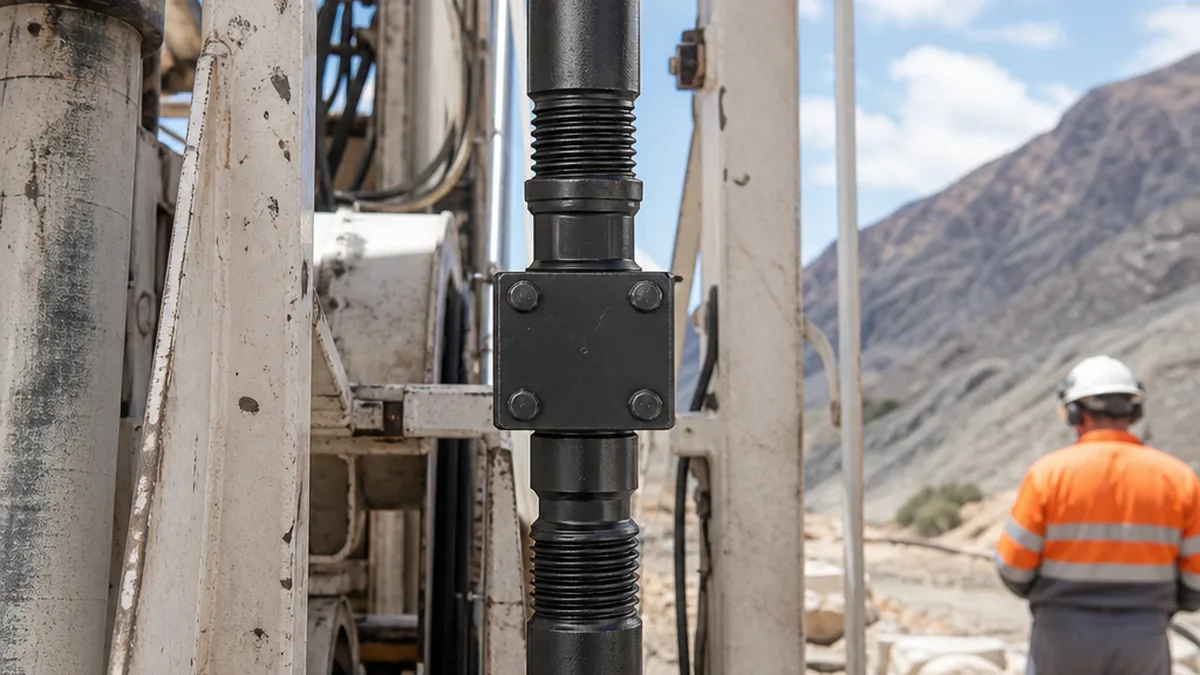
How the inner-tube assembly travels through the string
The inner tube is part of the inner assembly of a wireline core barrel and sits inside the outer barrel near the bit face. As the bit rotates and cuts, the core slides into the inner tube while the outer rod string keeps turning. When the inner tube is full, a wireline overshot tool is lowered through the rod string on a thin steel cable.
The overshot latches onto the spearhead at the top of the inner tube. Hoisting pulls the assembly straight up through the drill rods to surface — no rod removal required. Understanding how these wireline core barrel components work together is essential for reliable core retrieval.
That cable is what gives wireline coring its name. The core barrel inner assembly rides the wire; the rod string never moves.
Why wireline retrieval is faster than conventional rod-pull methods
In a conventional system, recovering core means breaking the entire drill string at surface, pulling every rod joint by joint, extracting the core barrel, reloading, and running the string back down. At 500 feet, that cycle takes 45 minutes to over an hour per run.[5]
With wireline retrieval, the same cycle takes 10–15 minutes regardless of hole depth, because only the inner tube moves.[6] Depth is no longer the enemy of cycle time. That efficiency gap compounds across thousands of feet — wireline systems routinely recover two to three times more core footage per shift on deep holes.
Wireline vs. Conventional Drill Rod: Which System Fits Your Project
The choice isn’t always wireline. Understanding the trade-off by project type prevents over-specifying equipment you don’t need — or under-specifying equipment that will fail at depth. https://www.youtube-nocookie.com/embed/JliJr9iwMuA Video: See Why Choose High Performance Drill Rod For WireLine Core Drilling
Head-to-head comparison table: wireline vs. conventional
| Factor | Wireline drill rod | Conventional drill rod |
|---|---|---|
| Core retrieval method | Inner tube pulled by overshot/cable | Full rod string pulled and disassembled |
| Retrieval time at 500 ft | ~10–15 minutes | ~45–90 minutes |
| Depth capability | Excellent (designed for deep hole coring) | Degrades quickly beyond ~200 m |
| Rod cost per joint | Higher (tighter tolerance, thicker wall) | Lower |
| Rig requirements | Larger, needs wireline winch | Simpler, smaller rig |
| Best application | Mineral exploration, deep coring | Shallow geotechnical, water well |
| Core diameter options | AQ through PQ | Limited standardization |
When conventional rod strings still make more sense
Conventional rods are still the right answer in three specific scenarios: shallow geotechnical holes under 50 meters, water well drilling where core recovery is not required, and budget-constrained site investigation projects where hole depth won’t exceed 100 meters. Below that depth threshold, the time penalty for rod-pull retrieval is manageable, and the lower rod cost makes sense.
⚖️ Trade-off: Conventional rods cost less per joint but the labor and rig-time cost of pulling the string at depth makes them more expensive per foot of core recovered beyond ~300 m. Run the math on your specific depth before defaulting to the cheaper rod.
Rod Size Designations Explained: AQ, BQ, NQ, HQ, and PQ
The wireline size series follows the DCDMA (Diamond Core Drill Manufacturers Association) standard. Each letter designation corresponds to a fixed set of outer diameter, inner diameter, and core diameter dimensions. Sizes are not interchangeable — a BQ overshot will not retrieve an NQ inner tube.
What the size codes actually mean in millimeters
Per the DCDMA wireline rod standard[1]:
- AQ: Rod OD ~57 mm, core diameter 27 mm — smallest wireline size, very shallow applications
- BQ: Rod OD ~73 mm, core diameter 36.5 mm — light mineral exploration, softer ground
- NQ: Rod OD ~89 mm, core diameter 47.6 mm — the most common exploration size globally
- HQ: Rod OD ~114 mm, core diameter 63.5 mm — high-volume exploration, deeper holes
- PQ: Rod OD ~140 mm, core diameter 85 mm — large-diameter deep coring, pre-feasibility holes
Each step up in size means a larger core sample, a heavier drill string, and a bigger rig requirement.
Typical weight per foot for HQ rod and why it matters for rig selection
Standard HQ wireline drill rod weighs approximately 13.5 lb/ft (6.1 kg/m) for a 3-meter joint. At 1,000 feet of hole depth, that’s a drill string approaching 13,500 lbs (6,100 kg) of suspended steel — before you factor in drill collars, the core barrel, and the bit.
Rig pull-back capacity must exceed your maximum expected string weight by at least 30%. A drilling project manager who undersizes the rig on HQ depth targets will be fishing stuck rods before the third week. Check the rig’s rated pull-back against your deepest planned HQ interval before mobilization, not after.
Choosing size based on target depth and core diameter requirements
Start with the core diameter your geologist needs for assay and structural logging. Then work backward to the rod size that delivers it. A common mistake is choosing NQ because it’s familiar when the project’s target depth and planned follow-up holes actually warrant HQ — saving one rod size on the initial purchase costs more when you re-drill with the right equipment six months later.
For deep hole coring beyond 600 meters in hard rock, HQ is the practical floor. PQ is reserved for large-diameter pre-feasibility holes or formations where core breakage on smaller sizes is destroying recovery.

Material Strength and Wall Thickness: How Rod Specs Affect Deep-Hole Performance
At depth, a drill rod faces three simultaneous loads: torque from the bit rotating against hard rock, tension from its own weight in the string, and bending stress as the hole deviates. Steel grade and wall geometry determine whether the rod survives that combination for the duration of your drilling project.
High-strength alloy steel vs. standard carbon steel rods
Standard carbon steel rods work at shallow depths. Once you pass 300 meters, the fatigue cycles accumulate fast enough that carbon steel rods begin cracking at the thread relief grooves — the most stress-concentrated point on any joint.
High-strength alloy steel rods — typically manufactured from grades with yield strengths in the range of 690–1,000 MPa — handle the same stress cycles with significantly longer fatigue life. The alloy steel[2] used in quality wireline drill rods is also heat treated after forming to normalize grain structure.
Look for “heat treated” on the mill certificate, not just in the sales sheet. Without that post-forming treatment, the strength numbers on paper don’t translate to field performance.
At Sinocoredrill, we manufacture our wireline drill rods from high-strength alloy steel with full heat treatment, and our ISO 9001:2015 quality system requires mill certificate traceability on every production batch — a checkpoint that matters when your drilling project is 2,000 miles from the nearest spare.
How wall thickness influences torque capacity and fatigue life
Wall thickness is not a cosmetic spec. Thicker walls increase the rod’s section modulus, which directly raises its torque capacity and its resistance to bending fatigue. Thinner-wall rods reduce string weight — useful when your rig’s pull-back is marginal — but they fail faster under the combined torsion and bending loads that deep-hole coring produces.
As a practical rule: for hard abrasive rock requiring high bit weight and rotation speeds, specify heavy-duty wall thickness even if it adds weight to the string. The alternative is a fatigue fracture at 900 feet, and a fishing job that costs more than six months of rod upgrades.
Formation Type, Project Depth, and Other Field Variables That Drive the Decision
No rod spec sheet accounts for what’s actually in the ground. Formation type and hole depth are the two variables that override every default recommendation.
Soft and fractured formations vs. hard abrasive rock
In soft or highly fractured formations, core recovery is the primary problem — not rod strength. Thin-wall rods reduce the annular clearance between the rod and the borehole wall, which improves flushing and reduces core jamming. Wireline coring in these conditions also benefits from shorter inner tube runs to minimize core disturbance.
Hard, abrasive rock — granite, quartzite, ironstone — is where rod strength and bit selection dominate. High torque loads from diamond drilling tools working against competent rock stress the rod string at every joint. In these applications, you need high-strength alloy steel rods with robust thread forms.
The diamond bit and rod[3] system must be matched: oversized bits on undersized rods create eccentric loading that accelerates thread wear to the point where you’re re-threading joints every 10 shifts.
Depth thresholds where rod weight and stiffness become critical
Below 500 meters, rod string weight becomes a primary design variable. Below 1,000 meters, the cumulative weight of the drill string may exceed the rig’s rated capacity if you haven’t calculated string weight per foot against total depth before ordering.
Three depth checkpoints every drilling project engineer should verify:
- <200 m: Any size appropriate to core diameter requirements; rod strength is not a limiting factor
- 200–600 m: Shift to high-strength alloy steel; verify rig pull-back against calculated string weight
- >600 m: Heat-treated alloy steel mandatory; check thread fatigue ratings; consider flush-joint rods to reduce hydraulic friction losses
⏱️ Time saver: Calculate your maximum string weight before mobilization using rod weight per foot × maximum planned depth × 1.3 safety factor. If it exceeds 80% of your rig’s rated pull-back, you need either a larger rig or a smaller rod size.
Evaluate Your Supplier Before You Order: Quality and Service Checkpoints
The drill rod you buy is only as good as the quality system that made it. A rod that looks correct on the outside can have inconsistent wall thickness, off-spec heat treatment, or thread dimensions that are within the tolerance band on a caliper but will gall on the first makeup cycle at depth.
Certifications and quality-control standards to verify
Ask the manufacturer for three documents before placing an order:
- ISO 9001:2015 certificate — confirms a documented quality management system, not just claimed quality
- Mill certificates for the steel used in your specific order batch — traceable to the melt and heat treatment records
- Thread inspection reports — confirming thread pitch, taper, and relief groove dimensions against the DCDMA standard
We hold both ISO 9001:2015 and CE certification, and we provide mill certificate traceability as a standard part of every export order — not as an upsell. If a supplier cannot produce these documents within 48 hours of request, that’s a sourcing risk worth pricing into your decision.
📌 Remember: A “meets DCDMA standard” claim on a product page costs nothing to write. Thread inspection reports with actual measured dimensions cost something to produce — which is why suppliers who actually run the checks will share them readily, and those who don’t will deflect.
Lead time, after-sales support, and replacement-parts availability
For a US-based drilling project, lead time from an overseas manufacturer typically runs 4–8 weeks door-to-door, depending on order size and port congestion. Order a buffer of 10–15% additional rod footage above your calculated requirement — fatigue failures and fishing losses are not hypotheticals on deep holes, they’re planned-for events.
Verify that your supplier stocks overshot and latch components compatible with the rod series you’re ordering. A wireline system where you can’t source replacement inner-tube latches or overshot dogs within 5 business days is an operational liability, not a supply chain.
Sinocoredrill provides 24/7 customer support and maintains stock of recovery tools, core barrels, and thread accessories for all rod sizes we manufacture — because a drilling project services team working in Alaska or the Nevada Basin can’t wait three weeks for a latch.
Ask specifically: “What is your standard lead time for replacement inner-tube assemblies in my rod size?” The answer tells you more about operational readiness than any brochure claim.
Have a project or a spec sheet in hand? Talk to sinocoredrills.com — real engineers answer.
FAQ
What is the difference between wireline and drilling?
Wireline drilling is a core retrieval method where the inner tube is pulled to surface through the drill string using a wire cable and overshot tool, without pulling the entire rod string. Conventional drilling requires tripping all rods out of the hole to retrieve core. Wireline is significantly faster in deep holes, reduces rod wear, and is the standard method for mineral exploration projects in the United States exceeding a few hundred feet in depth.
What is the typical weight of a HQ drill rod per foot?
HQ wireline drill rod typically weighs approximately 8.4 pounds per foot. For a 1,000-foot hole, the rod string alone approaches 8,400 pounds, which directly affects drill rig tonnage requirements and safety load ratings. Project planners in the United States should confirm exact weights with the rod manufacturer, as wall thickness variations between standard and heavy-duty HQ rod can shift that figure slightly.
How to choose the right drill holder?
Match the drill holder, also called a rod holder or chuck, to the outer diameter of your specific wireline rod series — NQ, HQ, PQ, or BQ. Using a mismatched holder causes slippage, accelerated thread wear, and dropped strings. In the United States, most wireline rigs use manufacturer-matched chuck inserts, so confirm compatibility with your drill model and rod supplier before mobilizing to avoid costly field modifications.
Sources
[1] DCDMA Drill Pipe Manufacturers and Supplier China – Roschen — roschenmining.com
[2] ASTM A519 Seamless Mechanical Steel Tubing — tottentubes.com
[3] Drill String Design and Functionality | PDF | Bending — scribd.com
[4] What is a wireline drill rod? – Knowledge — leanomsdrill.com
[5] Wireline Drill Rods – Cost-Effective Drilling Solutions — di-corp.com
[6] Drill Rod Sizes: Explore AQ, BQ, NQ, HQ, PQ for Optimal … — sinodrills.com