
A water well drilling rig is a machine that advances a borehole into the ground to reach a reliable water-bearing aquifer — and choosing the wrong rig type for your geology can add significant costs to a single project through wasted footage, broken tooling, and remobilization costs. The right match between rig, soil, and well depth is the single biggest variable in well drilling cost and success rate.
Quick reference
| Attribute | Detail |
|---|---|
| Main rig categories | Cable tool, direct rotary, air rotary/DTH hammer, reverse circulation |
| Typical depth range | 50 ft (hand/cable tool) to 2,000+ ft (rotary rigs) |
| Formation match | Soft soil → mud rotary; hard rock → DTH/air rotary; mixed → direct rotary |
| Key U.S. standard | AWWA A100-15 (water well construction standard) |
| Drive mechanism | Percussion, rotary, or combination |
| Drill pipe size | Drill pipe size varies by application and rig configuration for water wells |
| Output measure | Borehole diameter varies by application; confirm sizing requirements with your project specifications |
What water well drilling rigs are
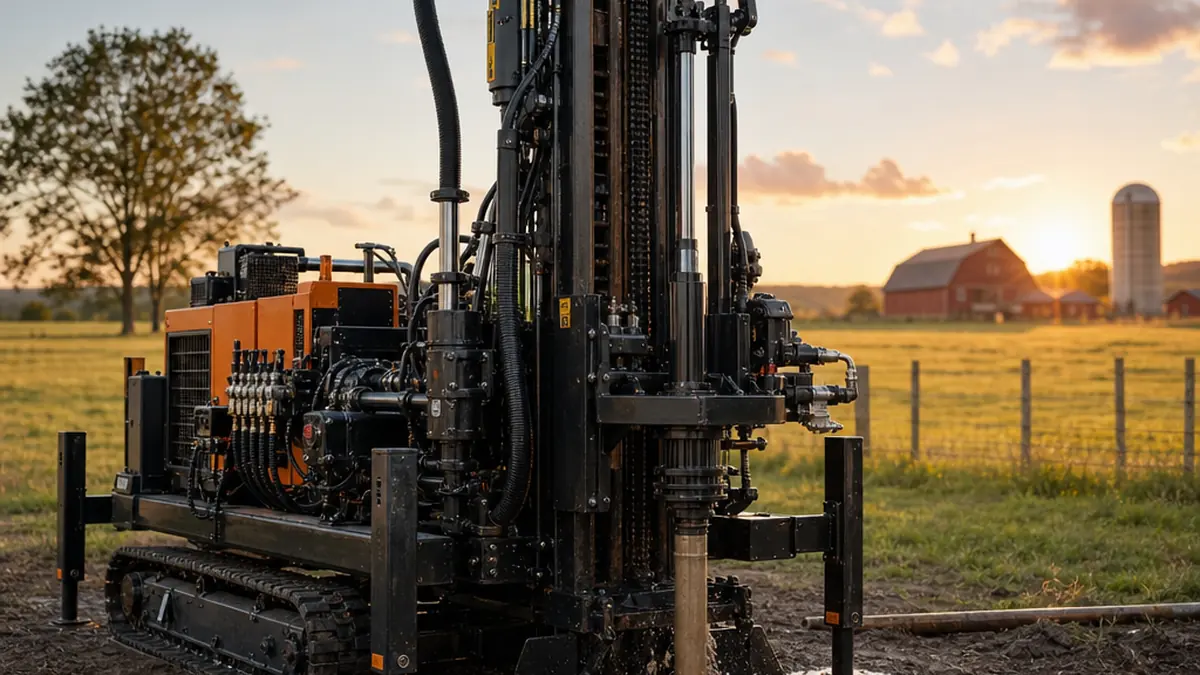
Every water well drilling rig shares one job: penetrate overburden and rock until the drill bit reaches a saturated zone that can sustain a usable yield. Beyond that shared purpose, rigs differ in how they break formation — by percussion, by rotation, or by a combination — and how they remove cuttings from the borehole. https://www.youtube-nocookie.com/embed/wuH1Td0slMQ Video: Every Drilling Rig Type Explained in 6 Minutes
The AWWA A100-15 standard[1] (source)[2]) is a widely referenced construction baseline for water wells in the United States, covering areas such as borehole diameter and grouting requirements. Readers should confirm the exact requirements and applicability of this or any other standard with their local authority having jurisdiction, as requirements can vary by state and locality.
Any rig you deploy on a U.S. well project should be capable of meeting applicable specs for casing, annular sealing, and disinfection access.
Understanding rig types is essentially understanding how different machines interact with different geological conditions. A mud rotary rig that flies through unconsolidated sand will stall and lose circulation in fractured granite. A cable tool rig that works methodically through cobbles would take weeks in deep clay that a rotary rig handles in hours. For a broader comparison of equipment used above ground, see our surface drilling rig types guide.
The four main water well drilling rig types
These are the rig categories a U.S. driller, project engineer, or rural property owner will actually encounter.
Cable tool rigs
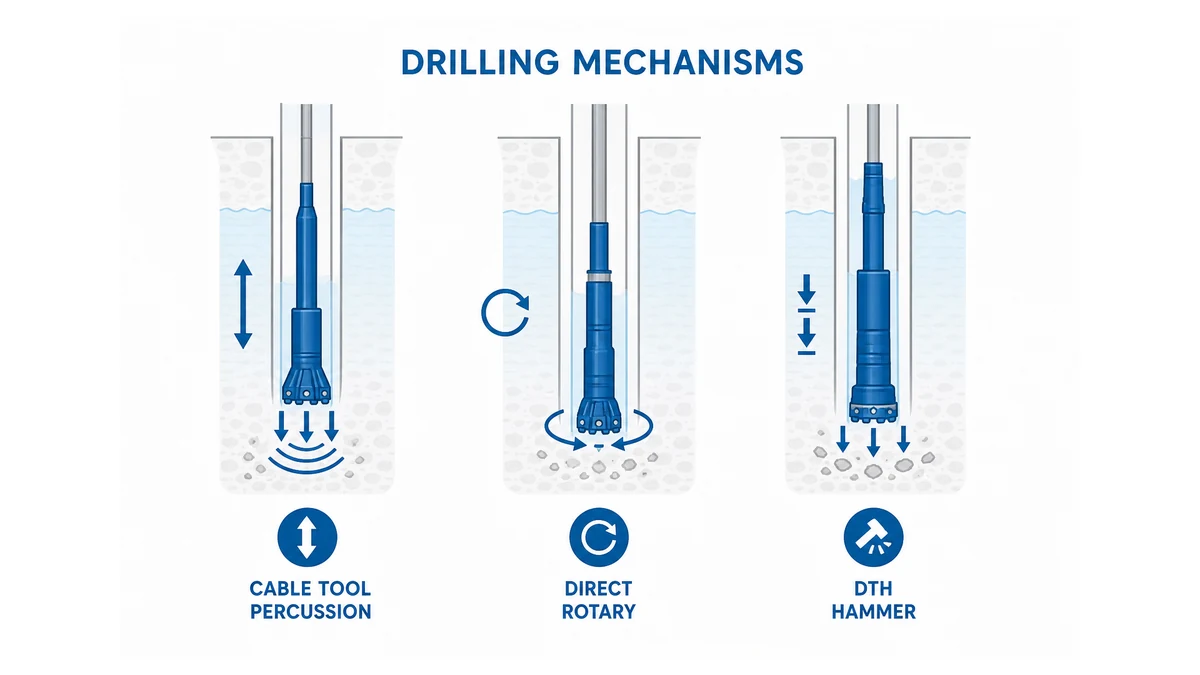
Cable tool drilling — sometimes called percussion drilling or “spudding” — works by repeatedly lifting and dropping a heavy drill string. The percussion action chips and crushes rock at the bottom of the borehole, and the cuttings are bailed out periodically with a bailer.
Cable tool rigs are slow by modern standards, advancing perhaps 10–50 feet per day in hard rock, but they shine in certain applications: cobble-and-boulder formations that destroy rotary drill bits, thin-bedded aquifers where you need precise formation sampling, and rural areas without a reliable water supply for rotary drilling fluid.[4] Many old-stock U.S.
rural wells were drilled this way, and cable tool rigs are still the preferred choice when formation water must be preserved clean for accurate yield testing.
⚖️ Trade-off: Cable tool rigs require minimal support equipment and use no drilling fluid — which protects the aquifer from contamination — but they are generally considered practical only to moderate depths in field use and produce borehole progress 3–5× slower than rotary rigs.[5]
Direct rotary rigs
Direct rotary drilling rotates a drill bit at the bottom of a drill pipe string while simultaneously pumping drilling fluid — usually bentonite mud — down through the pipe. The fluid cools the bit, stabilizes the borehole wall, and carries cuttings back up the annulus to surface.
This is the dominant rig type in U.S. water well drilling for one reason: it’s the fastest option in soft to medium formations — unconsolidated sand, clay, silt, and poorly cemented sedimentary rock. In the U.S. Gulf Coast and alluvial valley regions where aquifers sit in sediment, direct rotary rigs can achieve substantial daily footage in favorable conditions. The Great Plains presents mixed terrain: where sedimentary basins predominate, direct rotary rigs are well suited; where crystalline basement rock is encountered, air rotary and DTH hammer rigs are more appropriate. Both rig types operate across the Great Plains depending on local stratigraphy.
The trade-off is that bentonite mud must be managed on-site and properly disposed of, and the drilling fluid can temporarily plug fine-grained aquifer screens if the well isn’t developed aggressively after drilling.
Air rotary and down-the-hole hammer rigs
Air rotary rigs replace liquid drilling fluid with high-pressure compressed air. The air lifts cuttings from the borehole and provides some cooling to the bit. When combined with a down-the-hole (DTH) hammer — a pneumatic percussion tool that sits just above the drill bit — the rig delivers both rotation and rapid percussive blows directly at the rock face.
DTH hammer rigs are the standard choice for hard rock water well drilling in the United States — granite, basalt, quartzite, and the crystalline basement formations common across New England, the Appalachians, the Ozarks, and the Rockies. In competent rock, DTH hammer rigs are generally recognized as capable of substantially faster penetration rates than liquid rotary systems, though the degree of advantage depends on formation type and conditions.
The compressed air also provides instant visibility of formation water: when the returns suddenly carry water, the driller has hit the aquifer. For our customers working in hard-rock terrain, this is the rig configuration we most frequently recommend from our DTH equipment lineup, which has been refined across more than 20 years of field feedback from 40+ export markets.[6]
Reverse circulation rotary drilling
Reverse circulation (RC) rotary drilling inverts the conventional fluid path: air or fluid is pumped down the annulus, and cuttings are lifted back up through the center of the dual-wall drill pipe. This produces cleaner, less-contaminated formation samples and significantly higher cuttings-lifting capacity in large-diameter or deep boreholes.
RC rigs are used for large-diameter municipal water wells, deep exploration boreholes, and formations where accurate stratigraphic logging is critical. The equipment cost and mobilization complexity are substantially higher than direct rotary, so RC is reserved for projects where borehole diameter or sample quality justifies it.
How geological conditions drive rig selection
Formation type is the primary decision variable — not depth alone, not rig brand, not driller preference.
| Formation type | Recommended rig | Avoid |
|---|---|---|
| Unconsolidated sand/gravel | Direct rotary (mud) | Cable tool (too slow) |
| Hard crystalline rock | Air rotary / DTH hammer | Mud rotary (poor penetration) |
| Cobble/boulder | Cable tool | DTH hammer (deviation risk) |
| Mixed soft+hard | Direct rotary with tricone bit | DTH (bit damage in soft zones) |
| Large-diameter municipal | Reverse circulation | Cable tool (impractical) |
| Fractured limestone/karst | Air rotary or cable tool | Mud rotary (lost circulation) |
📌 Remember: Lost circulation — where drilling fluid vanishes into open fractures — is the most expensive surprise in water well drilling. In karst terrain, air rotary or cable tool eliminates that risk entirely.
Manual techniques and their place in modern water supply work
Not every water supply project in the U.S. calls for a truck-mounted rig. Manual techniques — jetting, hand augering, and sludging — remain relevant for shallow monitoring wells, geotechnical and environmental exploration, and site investigation in remote locations where rig access is physically impossible. These manual approaches are distinct from the four main mechanical rig types described above and are subject to significant depth and diameter limitations.
Manual water well drilling methods rely on water jetting (pumping water at pressure through a small-diameter pipe to fluidize and lift cuttings), hand-powered augers for depths to roughly 30 ft in cohesive soil, and sludging (a bailer-and-water combination). Auger drilling in particular is suited to shallow, unconsolidated soils and environmental monitoring wells; it is a manual technique with meaningful depth and diameter constraints, and should not be considered interchangeable with the four main mechanical rig types. These approaches can reach aquifers at shallow to moderate depths in favorable unconsolidated material and cost a fraction of a mechanical rig day rate.
Their limitation is obvious: they cannot penetrate rock, they are depth-limited, and they produce small-diameter boreholes that limit pump size and long-term yield.
Manual methods become impractical beyond a depth that varies with formation type — in sand or clay, that practical limit is generally reached well before a mechanical rig would be considered, and a mechanical rig is the only viable path for deeper targets. For permanent domestic or agricultural supply wells in most U.S. regions, a mechanical drilling rig — cable tool, rotary, or DTH — is the correct tool.
Mechanical rig methods: the decision the driller makes on-site
Even after a rig type is selected, the driller makes real-time mechanical choices that affect well quality: drilling fluid weight and viscosity management in rotary drilling, air pressure and hammer blow frequency in DTH work, rotation speed and weight-on-bit in all rotary systems, and casing advancement timing to prevent borehole collapse.
The drilling process is not just about the rig — it’s about how the rig is operated in the specific geological conditions at that borehole. A rotary rig over-drilling with excessive mud weight can permanently plug an aquifer. A DTH rig pushing too hard in fractured rock can deviate the borehole or lose the hammer downhole.
These are the mechanical discipline points that separate a drilled well with 5 gallons per minute sustained yield from one that tests at 5 gpm but declines to 1 gpm within 90 days.
Our equipment at Sinocoredrill is designed with this operational reality in mind — our drill rods and drill pipes are manufactured to quality-certified tolerances; readers should confirm applicable certification requirements with their project specifications and local authority, as standards can vary by application and jurisdiction.
⏱️ Time saver: Match your rig type to the formation before mobilizing — a preliminary site investigation to confirm the shallow stratigraphy can save a full day of rig time if it reveals boulders or bedrock shallower than the driller expected. Note that the appropriate investigation method should be matched to the formation: hand augers are suitable for cohesive soils, but other methods may be needed where boulders or rock are suspected.
What the different types of well drillers actually do
The rig type often determines the driller specialty. Cable tool drillers are a shrinking but specialized workforce — typically small owner-operator firms serving rural areas in the Upper Midwest, Appalachia, and the Northeast. Rotary drilling contractors dominate the Mid-Atlantic, Southeast, and Great Plains sedimentary basins. DTH and air rotary specialists cluster where crystalline basement rock is the primary aquifer source.
U.S. state water well driller licensing requirements[3] vary by state and locality; readers should confirm the specific licensing and permitting requirements applicable to their project with their state agency or local authority, as rules differ considerably across jurisdictions. The National Ground Water Association (NGWA) maintains a contractor directory organized by state and specialty.
Understanding which rig type fits your site’s geology isn’t just a procurement decision — it determines whether your well produces the yield it’s designed for, for the decades of service life a properly cased and grouted water well should deliver.
Have a project or a spec sheet in hand? Talk to sinocoredrills.com — real engineers answer.
FAQ
What are the different types of water well drilling rigs?
The main water well drilling rig types covered in this guide are cable tool rigs, direct rotary rigs, air rotary/DTH hammer rigs, and reverse circulation rotary rigs. Cable tool rigs use percussion, direct rotary rigs use a rotating bit with circulating drilling fluid, air rotary and DTH systems are suited to competent hard rock, and reverse circulation rigs are used where large boreholes or cleaner formation samples are required.
Which water well drilling rig is best for hard rock?
Air rotary and down-the-hole (DTH) hammer rigs are generally the best choices for hard, competent formations such as granite, basalt, and quartzite. Compressed air removes cuttings from the borehole, while a DTH hammer combines rotation with percussive blows directly at the rock face. Actual rig selection should also account for fractures, required borehole diameter, target depth, and local geological conditions.
How do geological conditions affect water well drilling rig selection?
Formation type is one of the most important factors in rig selection. Direct rotary drilling is well suited to unconsolidated sand, clay, and sedimentary formations, while air rotary or DTH systems are better suited to competent hard rock. Cable tool drilling can be useful in cobble-and-boulder formations, and reverse circulation is often considered for large-diameter or deep boreholes where cuttings removal and sample quality are important.
Sources
[1] AWWA COMMENT PERIOD ON AWWA A100, Water Wells — awwa.org
[2] https://store.awwa.org/AWWA-A100-15-Water-Wells-PDF — store.awwa.org
[3] Groundwater | Contractor state licensing and Exams — ngwa.org
[4] Drilling rig — en.wikipedia.org
[5] Water Well Drilling Rigs — geoprobe.com
[6] Understanding Well Drilling Rigs: A Quick Beginner’s Guide — prime-rigs.com